Re-Rendering Foreman’s Text for SleepWalkers
Introduction
Richard Foreman (1937–2025) founded the Ontological-Hysteric Theater in New York City in 1968 and spent over five decades building a body of work that refused nearly every convention audiences bring into a theater. His plays do not tell stories; they expose the act of watching.
Particle Theory, an unpublished script from 1973 produced at the Ontological-Hysteric Theater and Theater for the New City, occupies a pivotal place in his output. As Florence Falk has observed, the title names a distinguishing feature of Foreman’s works. An acute consciousness of the ambiguous / relative nature of matter, while presenting the ‘units’ or ‘particles’ of our way of being.
This casebook documents my dramaturgical study for a contemporary reworking of Particle Theory in the digital age, with six workshop proposals drawn from my practice as a theatre artist with a background in visual art and technology. It traces the philosophical architecture Foreman built across his essays and manifestos, argues for the urgency of this material under current conditions of digitally mediated perception, and presents six Dramaturgical Offers for the potential production team.
I. Foreman’s Philosophical Framework
Foreman’s philosophy begins with a decomposition of the word “understand” into its etymological roots: to stand under.
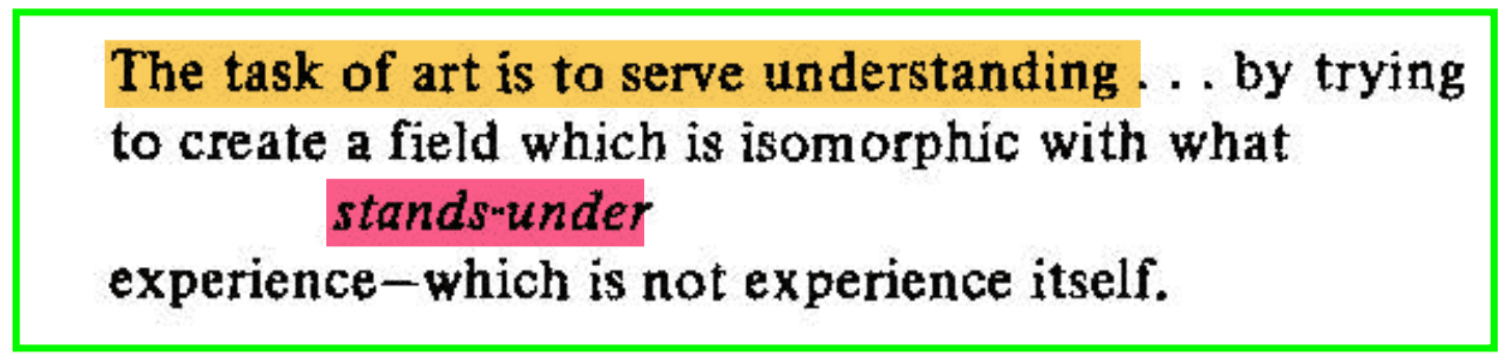
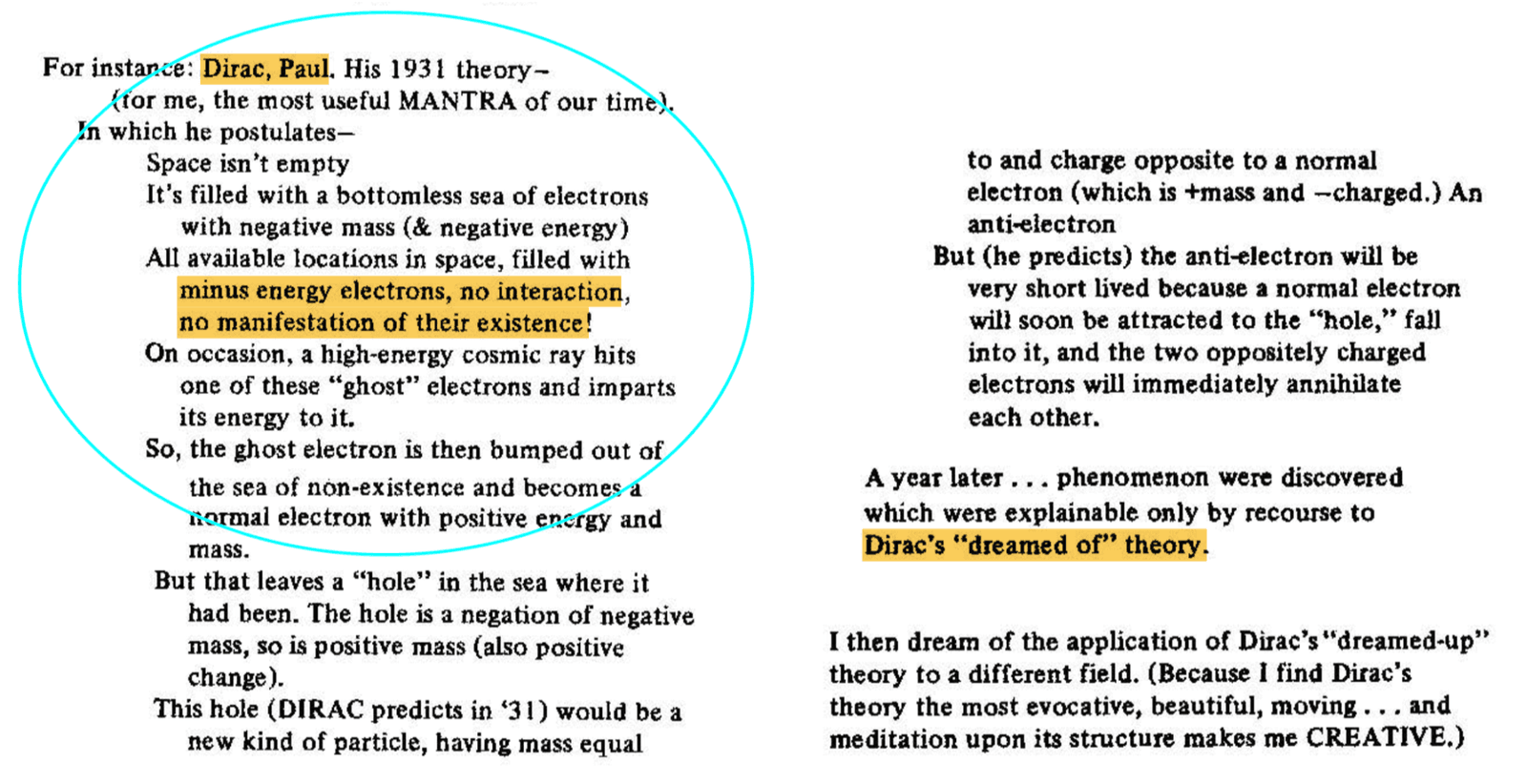
Art does not extract meaning from the flux of experience the way conventional drama does, compressing life into conflict, climax, and resolution. Instead, art’s task is to create a field that is isomorphic with what stands under experience—the perceptual laws operating beneath the surface of lived reality. Extraction kills the thing it represents. Isomorphism generates a parallel phenomenon to life itself. This principle finds its most vivid analogy in Paul Dirac’s 1931 theory of antimatter, which Foreman called his most useful mantra. Dirac postulated that empty space is filled with a bottomless sea of negative-energy electrons; a high-energy cosmic ray could bump one of these “ghost” electrons into observable existence, leaving behind a “hole” that behaves as a particle of positive charge — antimatter, predicted mathematically before it was observed in a laboratory. The direction is internal to outward. Dirac dreamed of the mechanism, and reality confirmed it. Foreman identifies this as the same direction his scripts follow, even though it is inexplicable from outside, but generated by an internal structural intuition the world later proves isomorphic with experience.
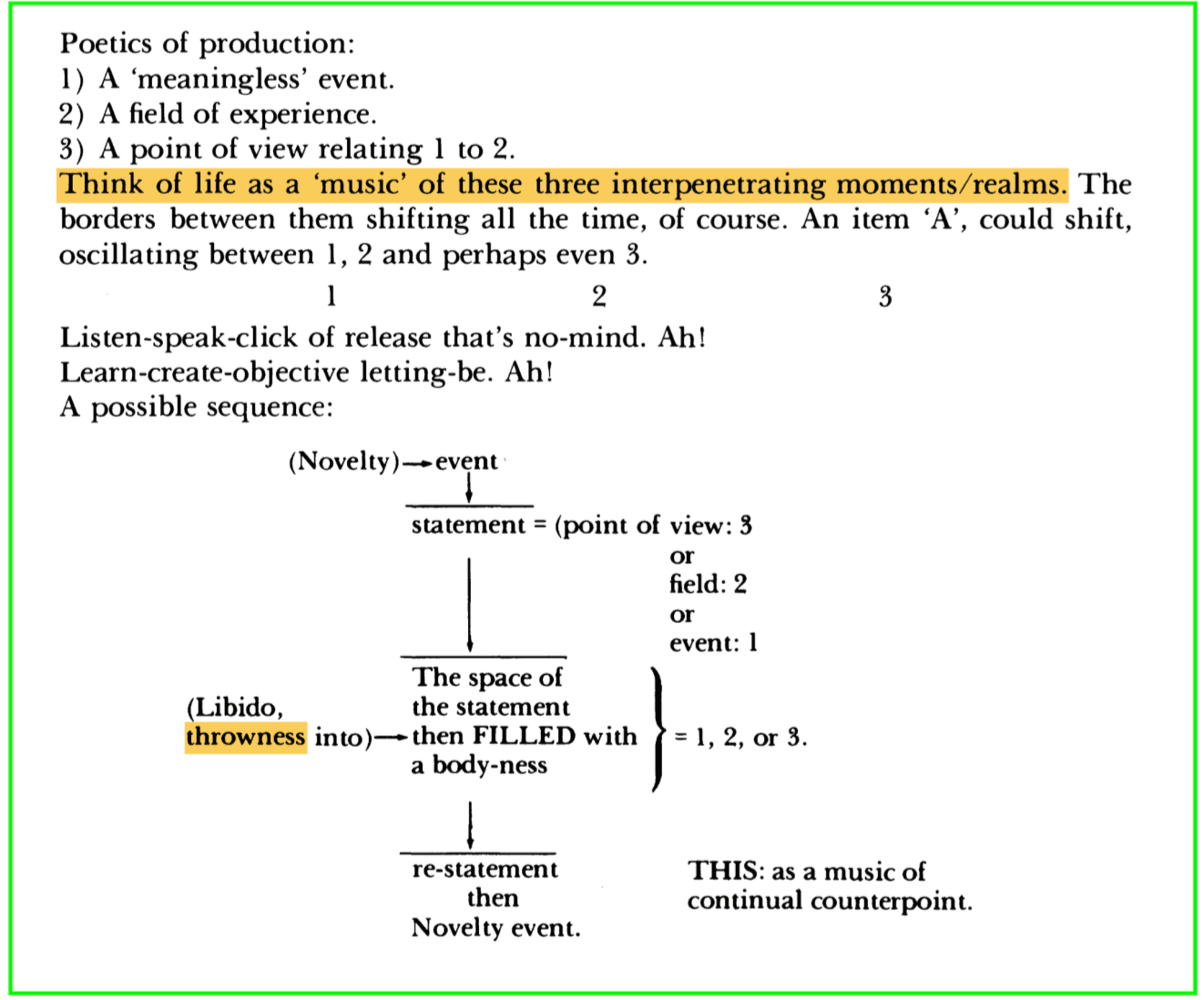
Several interrelated concepts organize this framework. The Poetics of Production, laid out in The Carrot and the Stick (1976), describes three interpenetrating realms—a “meaningless” event, a field of experience, and a point of view relating the two—that oscillate in continual counterpoint. This oscillation, fueled by what Foreman calls libido and throwness, is the engine of his theater. Thinking is not an abstraction but a sixth sense, as embodied as sight or touch (again, isomorphism?) He envisions a theater where the spectator’s mind is kept awake moment by moment, perceiving in small discrete units rather than swept along by narrative momentum ( the tendency to look through rather than at, Falk, 1977)
II. Why Particle Theory Now
Particle Theory was written before the internet. In 1973, the perceptual habits Foreman sought to disrupt—automatic watching, narrative hypnosis —were reinforced by stage and screen conventions in current days. Fifty-three years later, those mechanisms have been systematized at an infrastructural level. Seamless User Experience design, algorithmically curated feeds, smooth video transitions, and default camera perspectives have made the sleepwalking Foreman fought against not merely habitual but systemically reinforced. Foreman wrote that certain neurons protect us against the strength of incoming stimuli, so that we pick up experience on the frayed ends of a secondary system; real perception, he proposed, is resistance to perception. In 2026, that protective layer has been externalized into the design logic of every device we touch. Image technologies—cameras, displays, AI-generated content, recommendation algorithms—control perception more comprehensively than any previous cultural apparatus. The audience’s methods, instruments, and bodily relationship to devices have changed vastly. Any honest reworking must approach contemporary perception on its own terms.
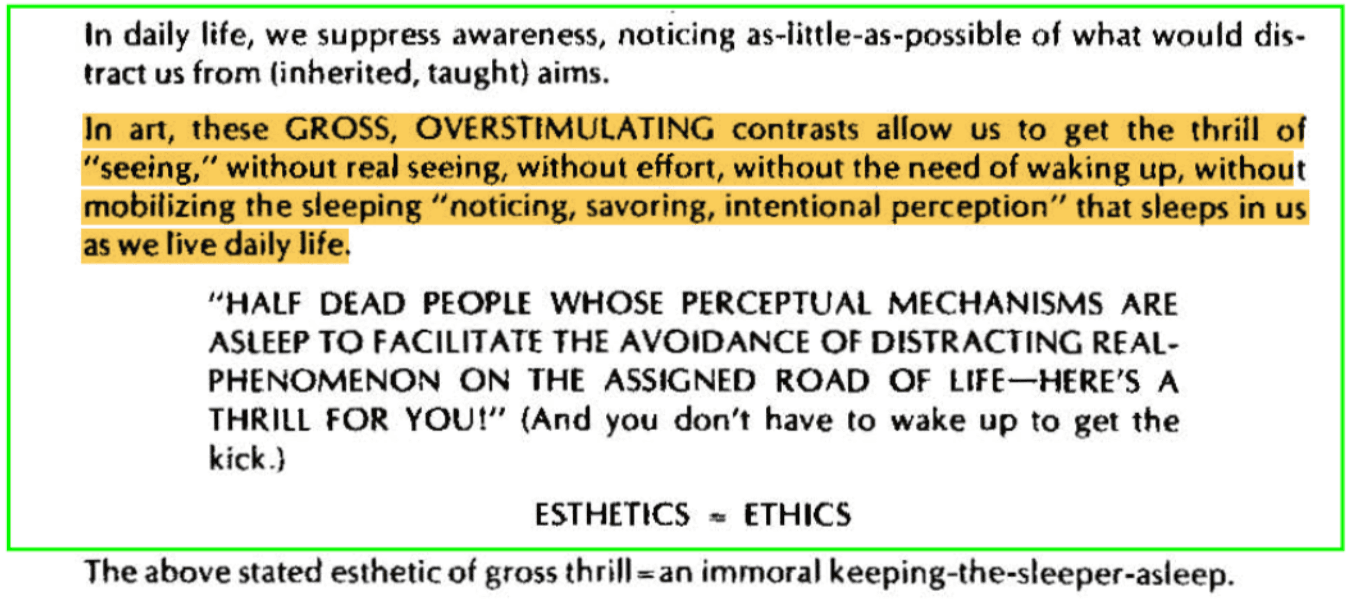
Foreman’s equation of aesthetics with ethics sharpens the urgency. When automaticity becomes systemic, when perception itself is designed to be frictionless, his disruption is no longer just an avant-garde gesture but an ethical imperative.
III. Six Dramaturgical Offers
Foreman's script is easily misread as random, chaotic writing — the kind that tempts performers and directors to interpret arbitrarily or pass over it without genuine engagement. But if one properly understands his way of thinking and his method of writing, one can reach the densely designed swamp of thought he has constructed and arrive at an original, grounded interpretation. This is precisely why such careful, meticulous groundwork is necessary. The casebook structures the production team’s entry into Foreman’s material through six Dramaturgical Offers: two foundational frameworks and four workshops.
#1 Foundation: How to Stand-Under introduces the ensemble to Foreman’s internal-discovery-outward process through the Dirac analogy and the Poetics of Production diagram. Rehearsal exercises explore what constitutes a “meaningless event,” how the oscillation between event, field, and point of view might be felt physically, and how performers can inhabit Foreman’s web of associations rather than interpreting it from outside.
#2 Adaptation: Why and How We Rework It Now is the chance to share the validity and importance of digital-age adapted version of the production, demonstrating how digital interfaces have systematized the sleepwalking Foreman identified and positioning the adaptation as a response to present conditions rather than nostalgia for the avant-garde.
The four workshops (#3-6) each translate a dimension of Foreman’s philosophy into embodied rehearsal practice.
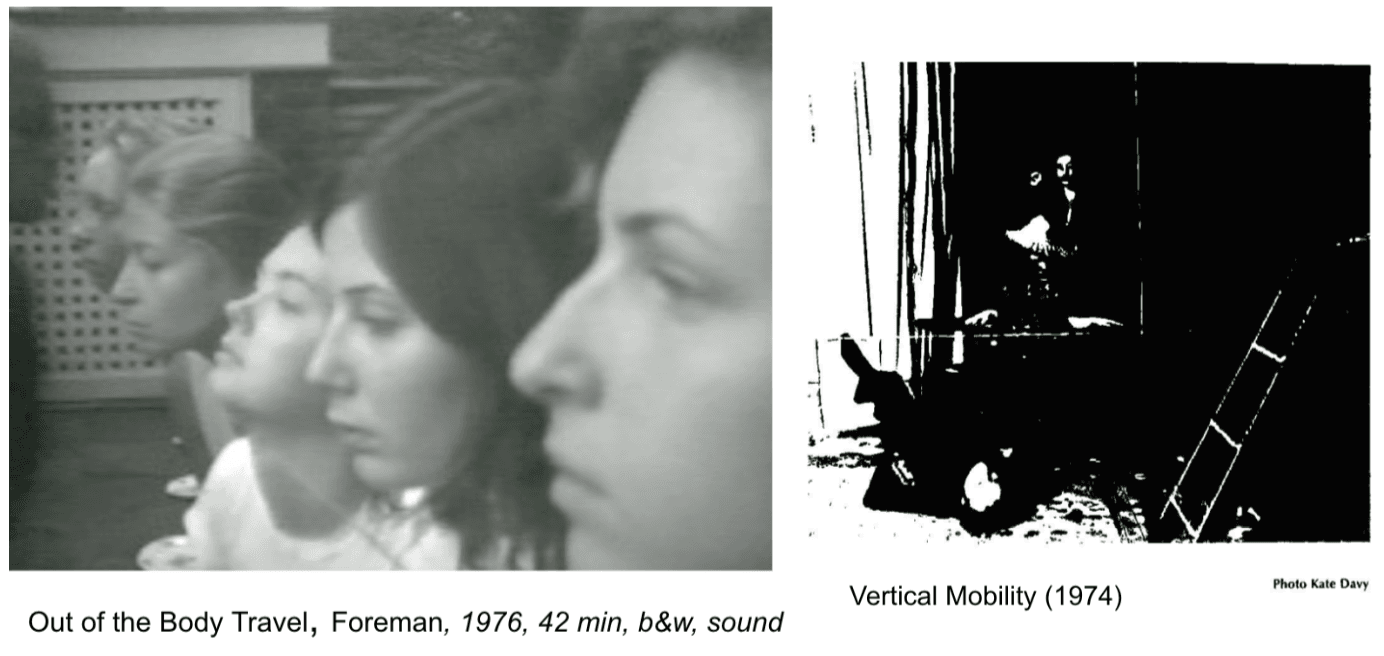
#3 Frames Workshop begins with Foreman’s visual and aural framing devices—strings, sticks, recorded sounds—and asks what frames we already live inside. Digital audiences inhabit frames naturally (tabs, windows, crops), but those frames have become seamless, invisible; the workshop uses Foreman’s film Out of the Body Travel (1976) and the string devices of Vertical Mobility (1974) to help performers feel each frame as a distinct medium of perception.
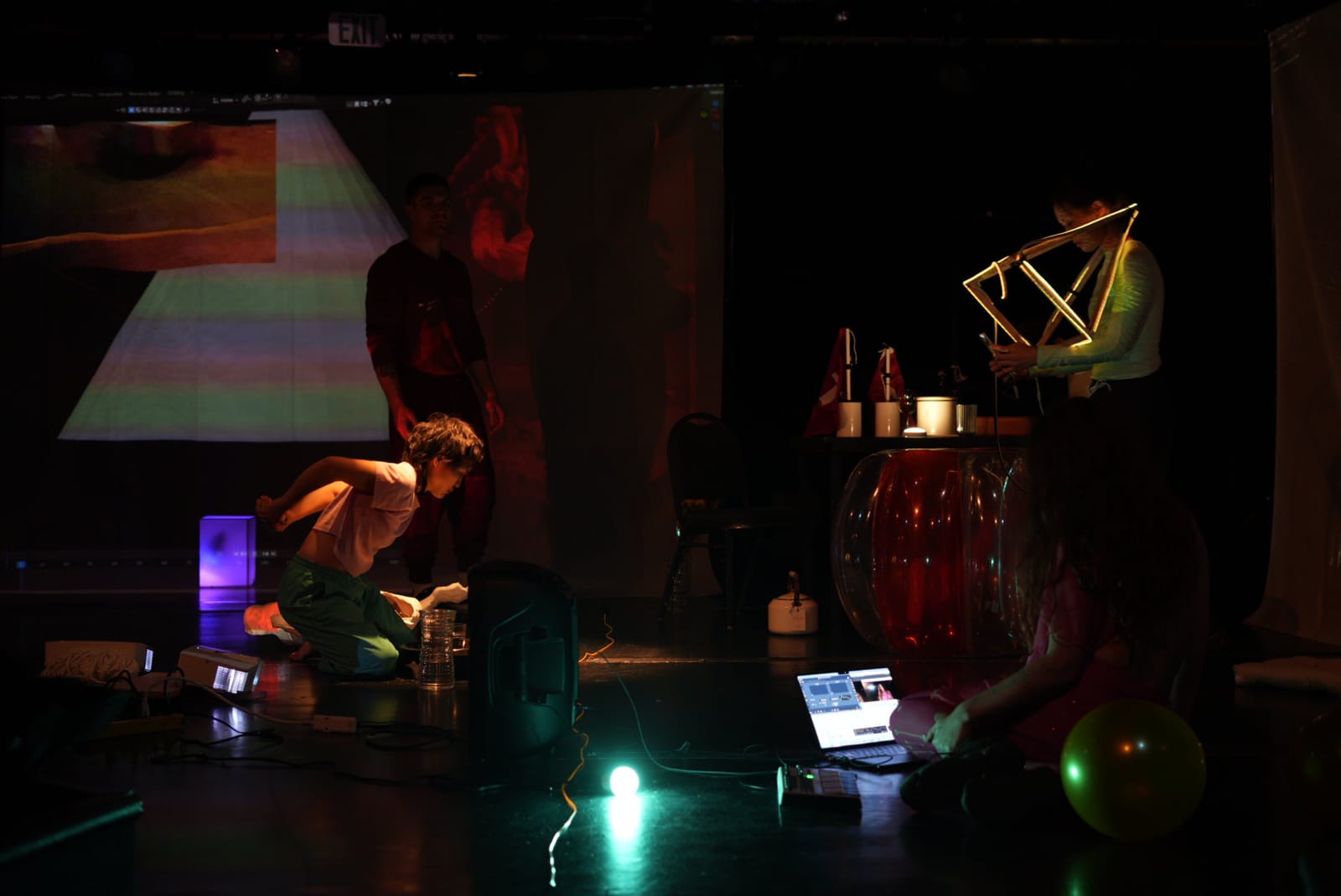
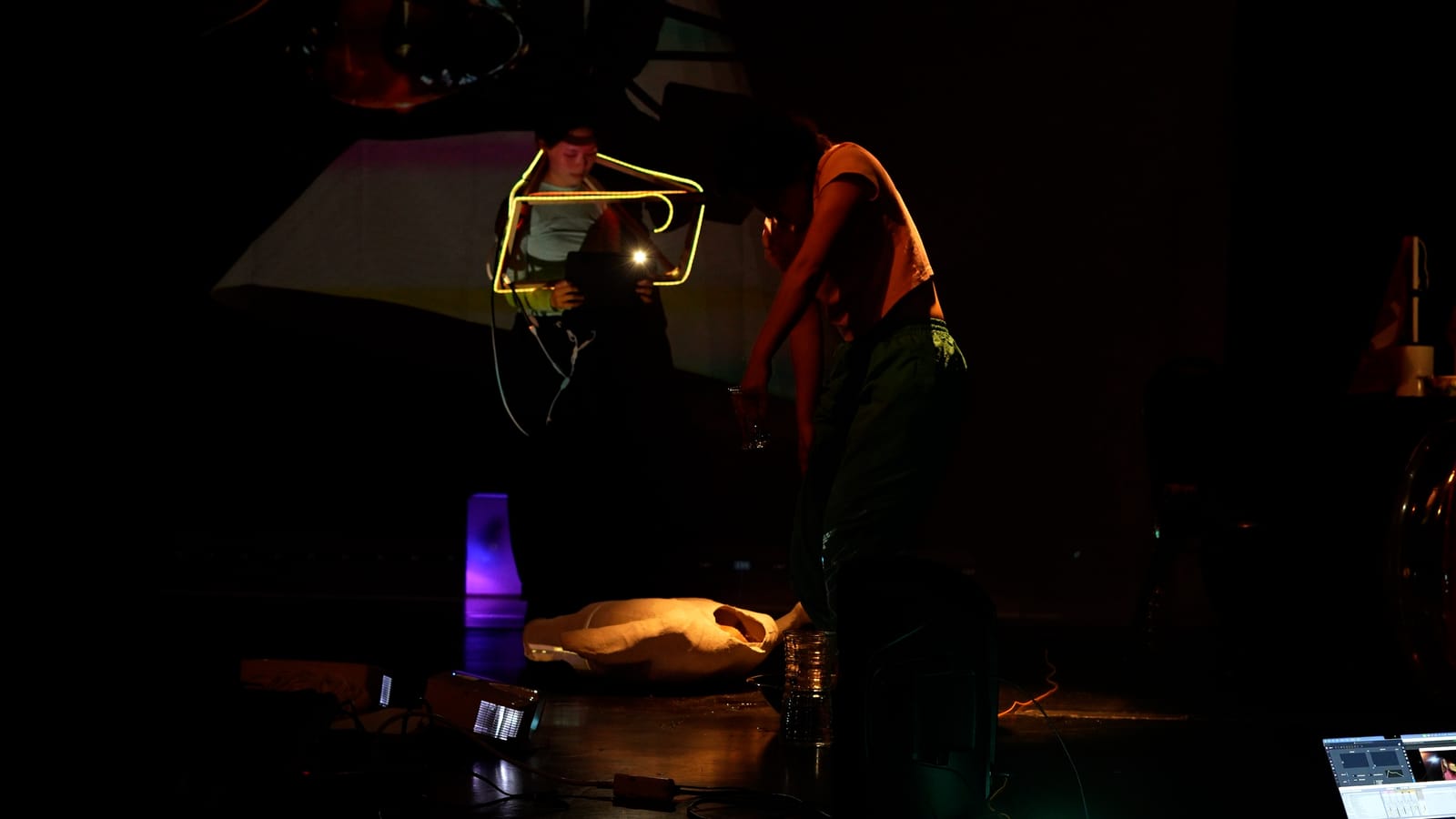
#4 Camera Workshop confronts the camera-screen apparatus. It consists of a camera operator placed visibly on stage with both a prop camera and a real camera feeding a live projection, as in the work-in-progress performance shown below. Benjamin observed that in film, mechanical equipment penetrates so deeply into reality that its pure aspect appears freed from the foreign substance of equipment — the apparatus disappears, and the image feels natural. He called this the orchid in the land of technology. This workshop reverses that disappearance. By exposing every layer of the apparatus on stage — the human holding the camera, the camera's UI, the subject being framed, and the resulting image on screen — performers and audience confront the full chain of mediated seeing that we have been trained to forget.
#5 Sense of Being Workshop is the time for sharing how we feel our being-ness digitally - socially - physically. Asking questions like What would be the ‘atoms’ of digital behaviors that we are embodying that Foreman tried to reveal? How do we project physical intuition onto non-physical / digital / psychic behavior? (I believe this is very related to human-computer-interaction research, where they study the skeuomorphic design that mocks the physics of reality for digital experience).
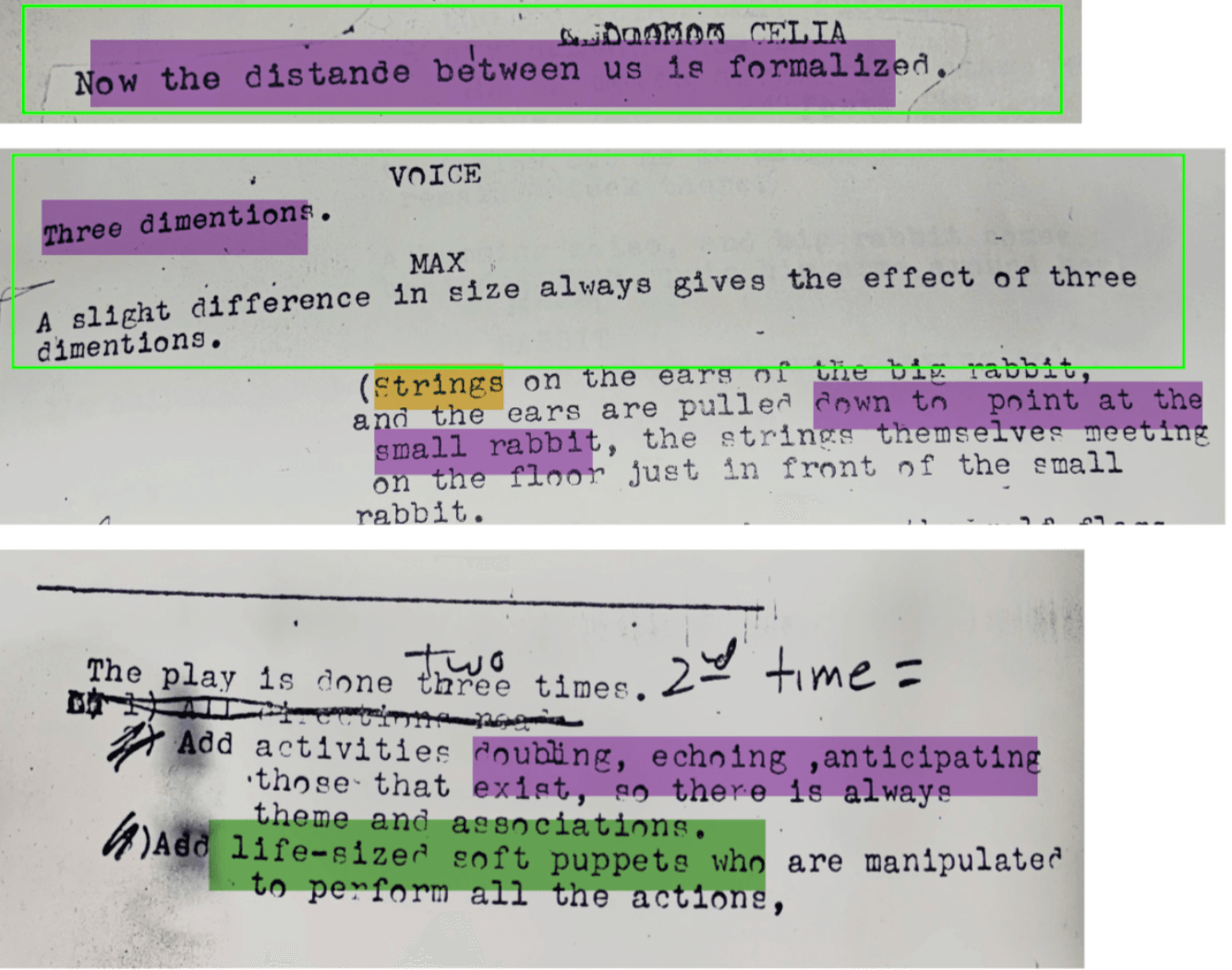
I imagine the Cartesian language Foreman deploys, ex. Now the distance between us is formalized, could be intuitively, bodily translated onto the atomic units of digital existence: actions (scroll, swipe, drag-and-drop), functions (play, replay, copy-paste), spaces (tabs, folders, layered windows), states (full, emptied, stacked), and temporal modes (pause, reverse, accelerate). These are the operational grammar shaping our ontological status. The contemporary vocabulary of WHAT-IT-IS-TO-BE-LIVING!
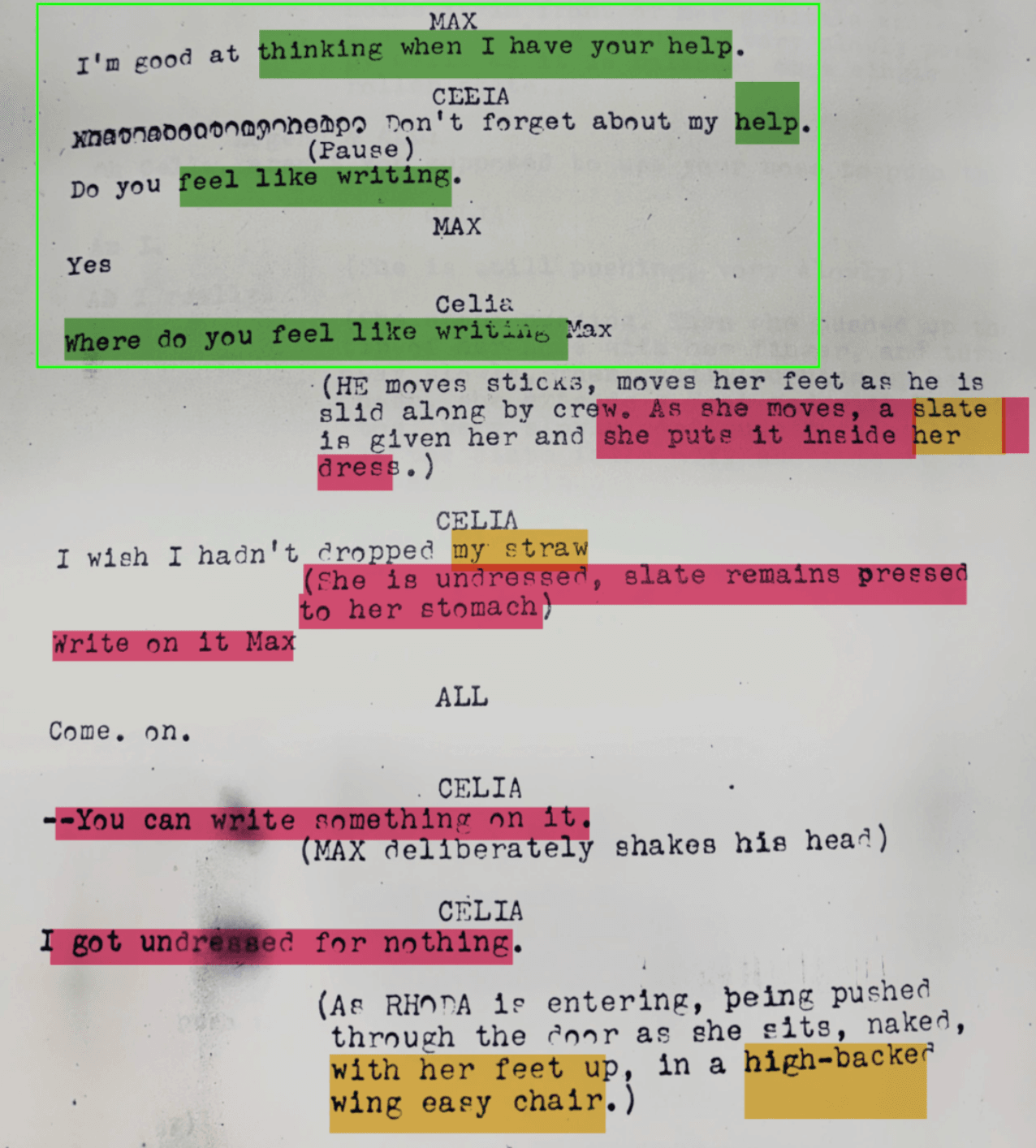
#6 Sex in Web Workshop addresses Foreman’s insistence that theater is about sex, the erotic charge between bodies in a shared space. In Particle Theory, female characters point to pleasure zones on a slate while male characters ask where to write. The tension between what and where produces an indescribable physicality. The workshop asks what our erotic charge looks like now and how Foreman’s unfolding of libido through a web of associations might be approached when the web has become literal and the dominant images of desire are algorithmically produced.
“Theater is about sex.
The theater is about people sitting in the audience, looking at other human beings, other bodies, finding them desirable, and not desirable. There’s always a huge erotic charge in the theater I think”
— The Ontological Cowboy (2005), Foreman
Conclusion
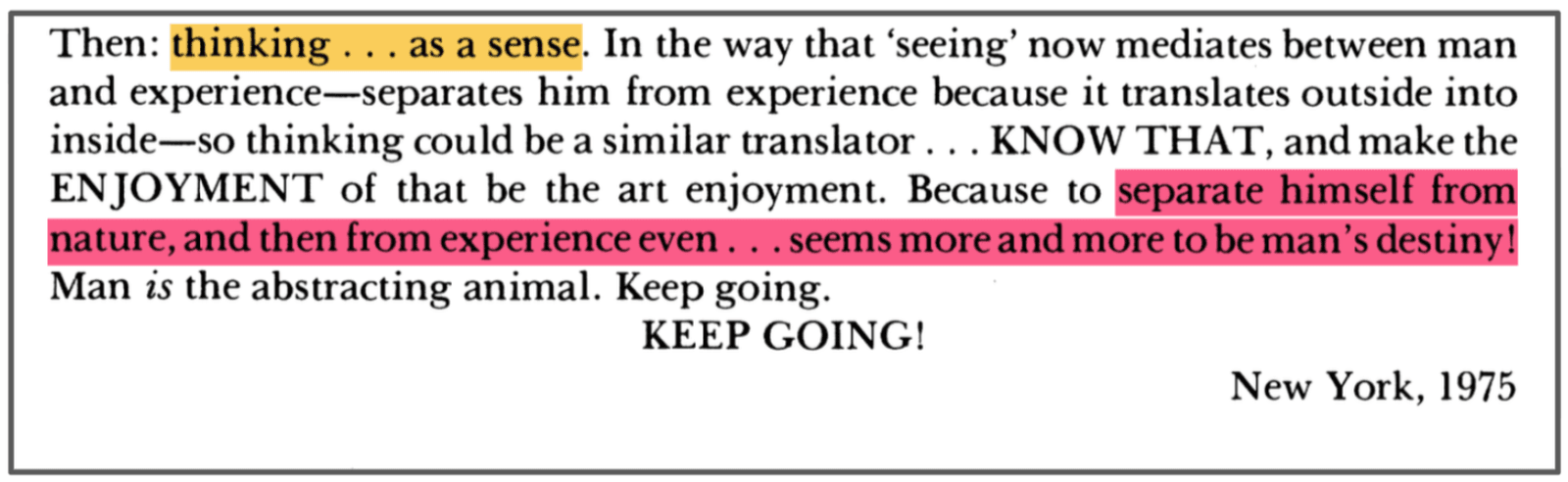
Foreman ended this essay The Carrot and the Stick with a vision of thinking as the next evolutionary sense. He did not mourn the separation from nature this implies; he wrote: KEEP GOING! This casebook takes that imperative. The six Dramaturgical Offers are designed not to preserve Foreman’s theater as a historical artifact but to continue the work he began. Making perception conscious, resisting the sleep that every era’s technologies enforce, and building theatrical machines that challenge the perceiving self on its own moment’s terms.
References
Benjamin, Walter. “The Work of Art in the Age of Mechanical Reproduction.” 1935.
Falk, Florence A. “Physics and the Theatre: Richard Foreman’s Particle Theory.”
Foreman, Richard. “The Carrot and the Stick.” Ontological-Hysteric Theater Vol. 1, Spring 1976.
Foreman, Richard. Particle Theory. Unpublished script, 1973.
Foreman, Richard. Plays and Manifestos. Ed. Kate Davy. New York: NYU Press, 1976.
Lakoff, George, and Mark Johnson. Metaphors We Live By. Chicago: U of Chicago P, 1980.
Marranca, Bonnie. The Theatre of Images. New York: Drama Book Specialists, 1977.